
Hospitality Economics
The lobby queue is more expensive than it looks
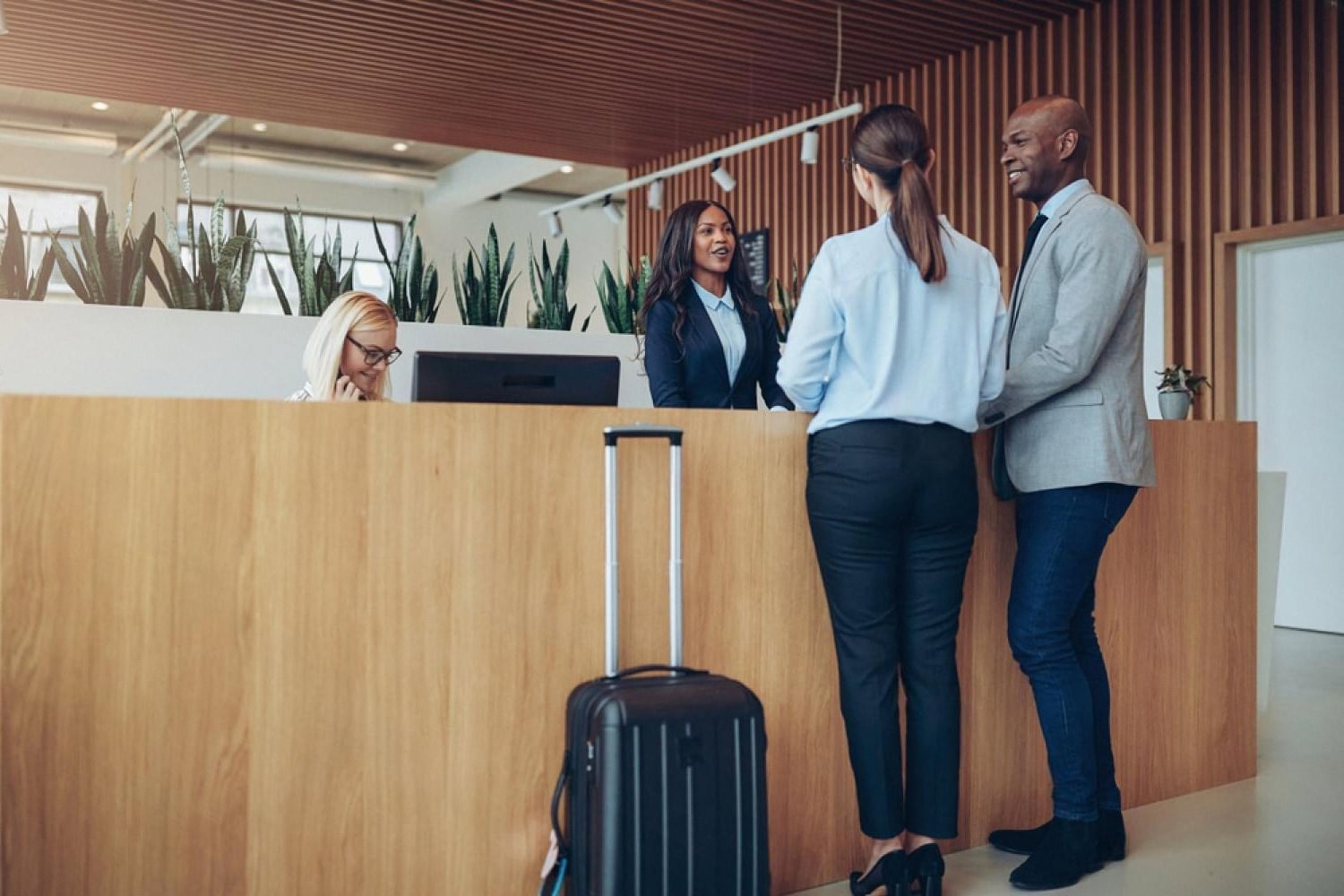
Most general managers in the US treat front desk wait times as a guest experience issue. It is also a balance sheet issue. The minutes a guest spends in line are minutes paid for in labor, missed upsells, and slightly lower scores on every review platform that matters.
A decade of digital transformation has reshaped airlines, banks, and quick service restaurants. Hotel lobbies, by contrast, still look a lot like they did in 2010. A clerk types into a property management system, prints a registration card, swipes a credit card, and codes a key. Every step is short. Stacked together, with one agent and four arrivals at 4 pm, the queue forms in under two minutes and takes thirty to clear.
The reason this persists is not that operators do not see the problem. It is that the cost of the queue is spread across three different P&L lines, so no single department owns it.
What the queue actually costs
Break a single check-in into its real components and the cost stops being abstract. A 200-room hotel running 70% occupancy serves roughly 140 arrivals a day. At ten minutes of agent time per arrival, that is 23 staff hours every 24-hour cycle just on registration, not counting questions, complaints, or repeat visits to the desk for keys that demagnetized.
The lost upsell is the line item most owners miss. The first 90 seconds at the desk are the only time most guests will ever consider a room upgrade, a late checkout, or a paid breakfast add-on. When the agent is rushing because three parties are waiting, the offer never happens. STR and Kalibri Labs estimate front desk upsells generate between $4 and $11 per arrival when actively pitched. On 140 arrivals, the unpitched scenario quietly leaves $560 to $1,540 on the table every day.

The labor shortage compounds the problem
A general manager in Phoenix or Charleston cannot simply schedule a third agent at the 3 pm arrival peak if there is no one to hire. That is the brutal calculus pushing properties toward a serious hotel check in system rather than another job posting. Self-service kiosks, mobile keys, and kiosk-assisted ID scanning move the bottleneck off the agent and onto the device, which is available 24/7 and does not call out sick.
There is also a quality angle here. An overworked agent at 5 pm makes mistakes: wrong room type, duplicate charges, misspelled names on the folio. Each error generates a callback, a manager visit, and sometimes a compensated stay. None of that shows up in the front desk budget, yet it is a direct consequence of the queue.

Traditional vs self check-in, side by side
Traditional front desk
- One agent, one guest, sequential queue
- Manual ID copy and card swipe
- Upsell pitched only if time allows
- Lobby crowding during 3 pm to 7 pm peak
- Scales by hiring, which is currently slow
Self check-in flow
- Parallel processing through kiosks or app
- Automated ID scan and PCI-compliant payment
- Upsell shown as a clickable screen, higher take rate
- Lobby reserved for guests who actually want help
- Scales by adding a device, not a payroll line
A simple ROI example for a 200-room property
Take the same 200-room US hotel at 70% occupancy. Cut average check-in from ten minutes to six by deploying modern hotel check in software with kiosk and mobile options. That is four minutes saved per arrival, across 140 arrivals a day, every day of the year.
The math
4 min saved × 140 arrivals × 365 days = 204,400 minutes = roughly 3,407 labor hours per year.
At a fully loaded $32 per hour, that is approximately $109,000 in annual labor cost avoidedbefore counting upsell uplift or review score gains.
Add a conservative $2 extra upsell per arrival and you recover another $102,000 a year.
Where the industry is heading
AI concierge
Voice and chat agents that pre-fill registration, answer property questions in 30+ languages, and handle late arrival requests without waking a night auditor.
Digital identity
State-issued mobile IDs in Apple Wallet and Google Wallet, combined with biometric matching, are quietly removing the need to photocopy a driver license at all.
Contactless arrivals
Pre-authorized payment, mobile key issued the morning of arrival, and a geofenced welcome message that bypasses the desk entirely for repeat guests.
None of these technologies remove the front desk. They re-purpose it. The clerk becomes a problem solver and a host for the 30% of arrivals who genuinely want human contact, while the other 70% move through in three minutes. That is the shift owners in the US are starting to fund, and it is why brands from Marriott to small independent boutiques are rewriting their lobby footprint for 2026.
The takeaway for owners and GMs
The queue at your front desk is not a service quirk. It is a recurring six-figure expense disguised as a guest experience problem. Audit your average check-in time this week, multiply it out, and the business case for a self-service layer usually writes itself.
Frequently asked questions
How long does hotel check-in take in the US?
Industry surveys put traditional, agent-led check-in at around 8 to 12 minutes per guest during peak arrival hours, and 4 to 6 minutes off-peak. Self check-in via kiosk or mobile app typically lands at 2 to 4 minutes, including ID verification and payment authorization.
Why do hotels still have long check-in lines despite digital transformation?
Three reasons. First, many properties bolted a mobile app onto a legacy PMS that still requires manual steps at the desk, so the digital flow is not actually end-to-end. Second, US hotels are still understaffed at the front of house after the 2020-2023 labor shock. Third, guests who do not use the app default to the desk, and one slow transaction at the front holds up everyone behind it.
Does self check-in really save money for hotels?
Yes, and the savings are usually larger than operators expect. A 200-room property that shaves four minutes off the average check-in can recover roughly 3,000 labor hours a year, equivalent to about $100,000 at a fully loaded agent cost. Most properties also see a measurable lift in upsell take rate because the kiosk and app show the offer to every guest, not just the ones the agent had time to pitch.
Is hotel self check-in worth it for guests?
For most travelers, especially business guests and repeat visitors, the answer is yes. Skipping the desk after a long flight is the main draw. The tradeoff is that the warm welcome and personalized upgrade conversation can disappear if the property does not keep a host on the floor. Good operators run a hybrid model: kiosks for speed, a roaming host for hospitality.
What is the impact of long check-in waits on reviews?
J.D. Power and other guest satisfaction studies consistently find that wait time at arrival is one of the top three drivers of a negative review, alongside room cleanliness and noise. A 10 to 15 minute queue can pull a property’s overall score down by 0.2 to 0.4 stars, which directly affects search ranking on Booking.com, Expedia, and Google.
What about security and ID verification with self check-in?
Modern kiosks and mobile flows use automated document scanning, liveness detection, and PCI-compliant payment tokenization. In practice they often produce a cleaner audit trail than a manual photocopy. US states are also rolling out mobile driver licenses in Apple and Google Wallet, which integrate directly with newer property systems.
Will AI replace front desk staff entirely?
Unlikely, at least for full-service hotels. AI concierges and self check-in tools handle the repetitive 70% of interactions, freeing staff to focus on complex requests, recovery moments, and high-value guests. The role shifts from data entry clerk to host. Limited-service and extended-stay properties are moving closest to a fully unattended model.

I am a traveler, blogger, and adventure seeker from Russia.
Traveling is not just a change of places, but a way of life, a way to learn about the world, meet amazing people, and discover new horizons.